
Counselling That Fits Into Real Family Life
Published August 2, 2026 • Updated August 24, 2026
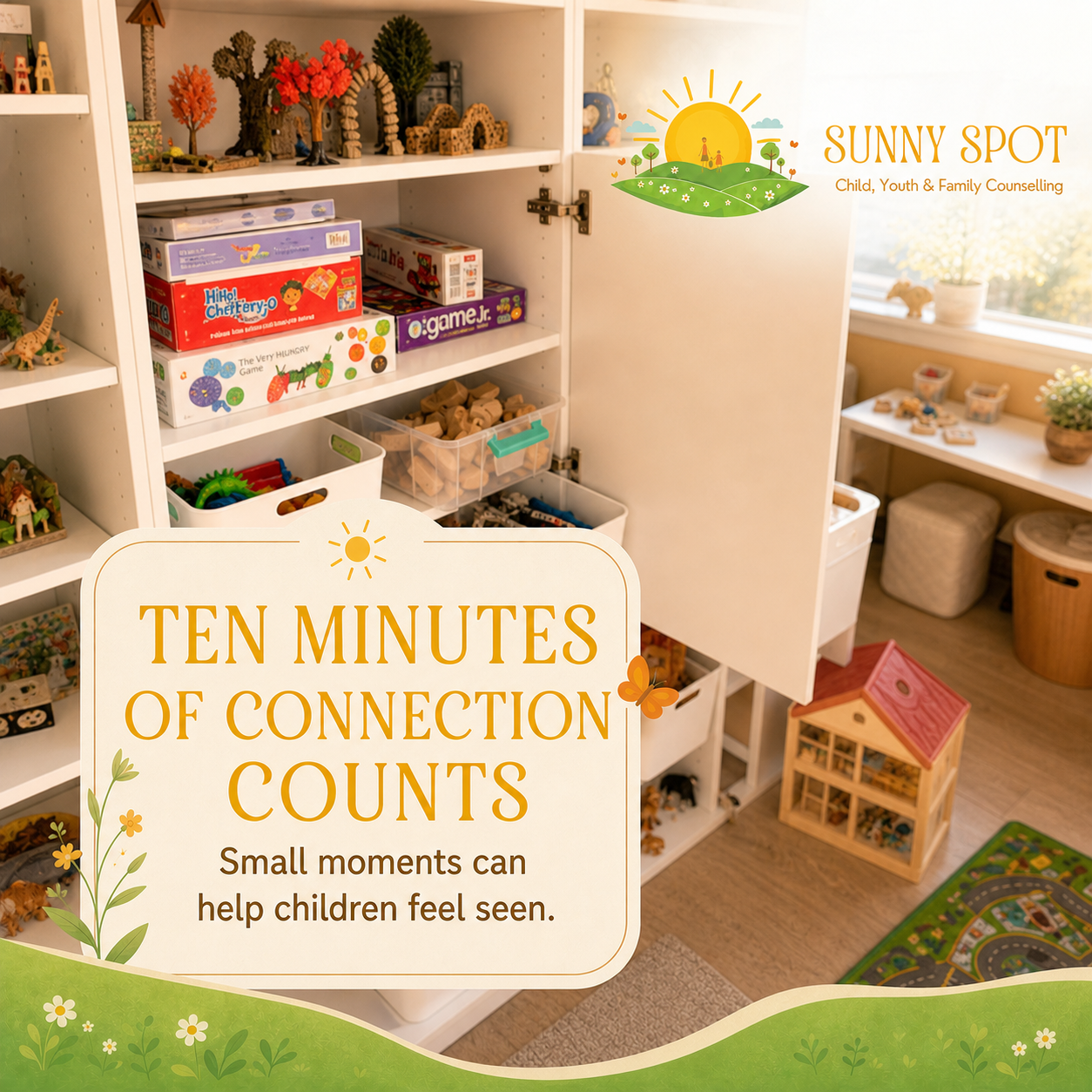
Many families carry a quiet awareness that support would help. The question is often not whether to reach out, but when.
Between school, work, soccer, Kumon, piano lessons, appointments, homework, and the daily responsibilities that fill a family week, fitting one more commitment into the schedule can feel genuinely impossible. For many caregivers, the barrier to starting counselling is not reluctance. It is time.
Counselling should feel like support, not like another source of pressure.
Appointments designed around real schedules
Sunny Spot offers appointments on Thursdays, Fridays, and Sundays, including evening options for families who need support outside regular school and work hours.
These options exist because families deserve access to support that fits their actual lives, not an idealized version of them. A schedule that works for your family means fewer barriers between you and the help you are looking for.
You do not need to have everything figured out first
A common hesitation before reaching out is not knowing exactly what to say or whether the situation is serious enough. You do not need to have a clear explanation prepared. You do not need to know which service fits best or whether counselling is definitely the right direction.
A free 15-minute consultation is available through the Jane booking link. It is a relaxed conversation where you can share what you are noticing and ask whatever is on your mind. There is no obligation and no pressure.
Many caregivers describe the first conversation as a relief. Simply speaking with someone who understands child and family support can help clarify what the next step might look like.
Support that includes caregivers, not just children
Child counselling at Sunny Spot is collaborative by design. Caregivers are considered an essential part of the process, not an afterthought. Sessions may include parent conversations, guidance for responding to big feelings at home, and practical ideas to use between appointments.
Caregivers often arrive carrying their own questions and worries alongside those of their child. Making space for that matters. Understanding what a child is experiencing can shift how caregivers respond, and that shift can ripple through the whole family.
Parent coaching and counselling for mothers are also available for caregivers who want a dedicated space to process their own experience alongside parenting support.
One step at a time
The goal at Sunny Spot is not to add to the list of things a family has to manage. It is to offer something that reduces the weight. A first step does not have to be a big commitment. It can simply be a question, a brief conversation, and a sense of what might be possible.
If scheduling has been a reason for waiting, it may be worth seeing whether a Thursday, Friday, or Sunday option could work. A brief consultation costs nothing and takes fifteen minutes. Many families find that simply having the conversation removes a weight they did not realise they were carrying.
Sunny Spot Child, Youth and Family Counselling serves Port Coquitlam, Coquitlam, Port Moody, and the surrounding Tri Cities area.
Support has to fit the capacity families actually have
A plan can be thoughtful and still fail if it assumes unlimited time, transportation, money, privacy or energy. Real families have work shifts, school pickups, siblings, caregiving responsibilities, cultural commitments, neurodivergent needs and weeks when everyone is simply tired. Useful counselling considers those realities without treating imperfect follow-through as resistance.
Begin with the smallest meaningful change
Instead of assigning a long home program, choose one practice connected to the family's main concern. It may be changing the first ten minutes after school, using one repair phrase or reducing questions at bedtime. A smaller plan is easier to observe honestly. If it helps, build from it. If it does not, revise without shame.
Caregiver involvement should be practical
Parents need enough information to support the child, while children and teens also need privacy and a relationship of their own with the counsellor. Involvement may include caregiver conversations, shared goals, general themes, environmental changes and occasional joint sessions. It should not require parents to become therapists at home or demand a transcript of private sessions.
School is part of many children's real life
When school is central to the concern, counselling should not pretend the problem exists only inside the child. With proper consent, collaboration may help clarify patterns, reduce conflicting expectations and identify supports that increase access. The young person's dignity and privacy remain important; not every detail needs to be shared.
Culture and family meaning belong in the conversation
Families may hold different understandings of emotion, parenting, privacy, respect, disability and help-seeking. A counsellor should ask rather than assume. The goal is not to impose one ideal family style. It is to understand what matters to the family and build support that is both ethically responsible and culturally respectful.
Neurodivergence changes what fit can mean
A strategy that depends on stillness, eye contact, quick verbal insight or complex organization may be inaccessible for some children, teens or caregivers. Sessions and between-session ideas can make room for movement, visual supports, processing time, sensory needs and direct language. The plan should reduce unnecessary demands rather than teach a person to hide differences.
Missed practice is useful information
If a family did not use an idea, ask why. Was it too complicated, introduced at the wrong time, forgotten, disliked by the child or impossible within the household rhythm? This is not failure. It is information about design. Modify the plan until it can live outside the counselling room.
What flexibility does not mean
Flexible care still requires clear boundaries, consent, professional scope and honest communication about what is available. It does not mean promising appointment times, formats or outcomes that have not been verified. It means making careful use of the options that actually exist and referring elsewhere when another service is needed.
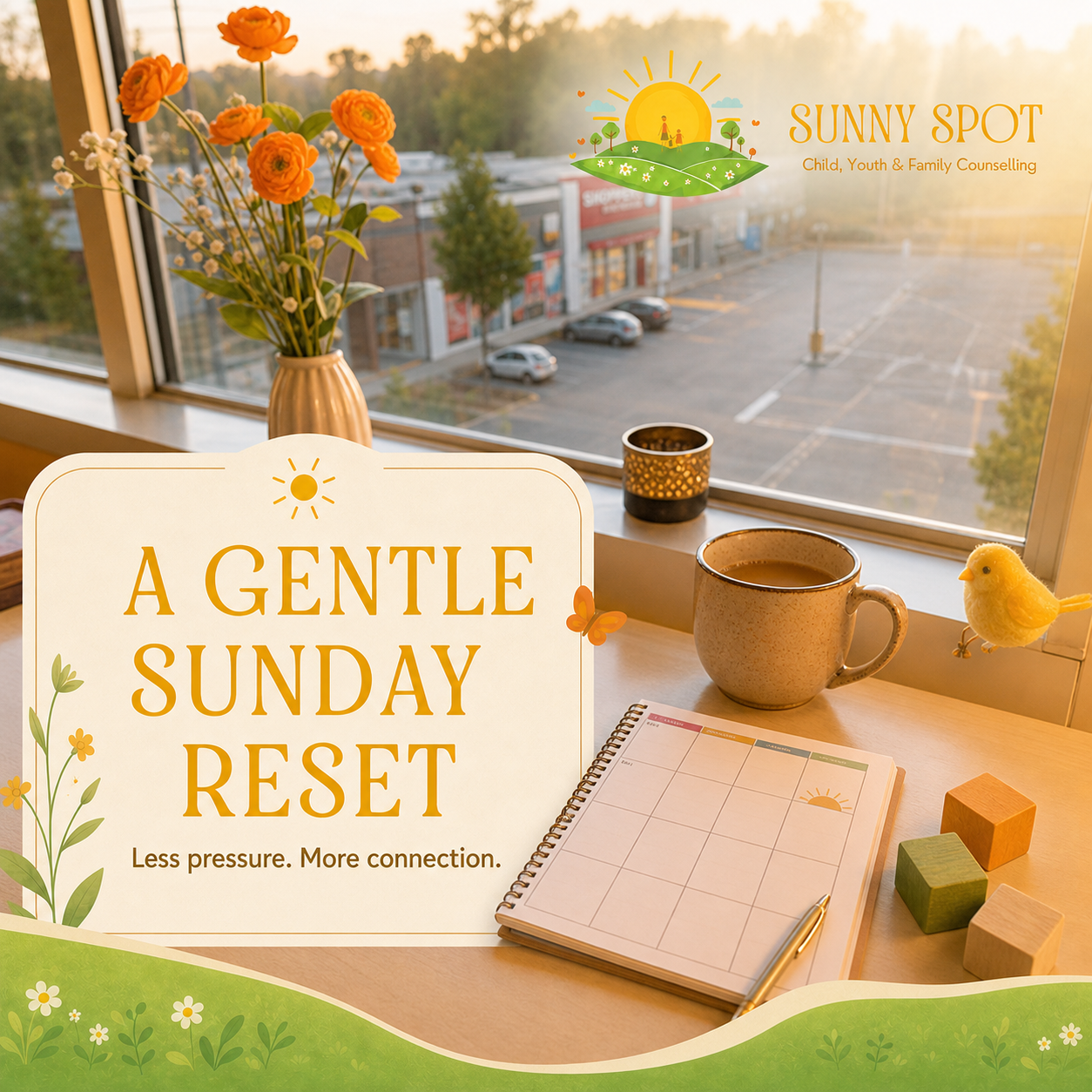
Sunny Spot's family counselling, parent coaching and child counselling are relationship-first and practical. The gentle Sunday reset offers one example of reducing pressure. A free 15-minute consultation can help clarify whether current services fit your family's needs.
Review whether the plan is helping
Every few weeks, return to the original concern. Is the family spending less energy on one repeated struggle? Is the child recovering with more support, communicating earlier or participating in something that matters? Are caregivers clearer about what to do next? Progress can be uneven, and goals may change. A plan should not continue simply because it was written down.
Also ask what the support is costing the family in time, stress and coordination. A small benefit may not justify a plan that consumes the household. Counselling should help make life more understandable and workable. When another professional, community resource or different approach is a better fit, responsible care includes saying so.
Good support is collaborative, transparent and open to adjustment.
Support does not depend on perfect homework
Some counselling approaches send families home with detailed practice plans. When life is already full, those plans can become another source of guilt. A child or teen should not lose support because a caregiver could not complete a worksheet, practice a skill every day, or remember every strategy. Useful counselling works with the capacity a family actually has. If a between-session idea does not fit your week, say so. Sheila can adjust the plan rather than treat imperfect follow-through as a lack of effort. The goal is support that lives inside your real routine, not an ideal one.
Questions families can ask during a consultation
- What would support look like for my child or teen given our current schedule?
- How much parent participation is expected, and in what form?
- What happens if we cannot practice something at home between sessions?
- How will we know whether the support is helping?
- Can sessions make room for movement, sensory needs, or processing time?
- What should we do if the concern involves school?
A consultation is a conversation, not a test. You do not need polished answers to ask these questions. Speaking honestly about your family's actual capacity helps Sheila suggest a realistic starting point rather than a plan that looks good on paper but cannot survive a busy week.
Common questions caregivers ask
Do we have to commit to a long plan right away?
No. A first step can be a single consultation to discuss what you are noticing and what options exist. From there, you and Sheila can choose a next step that fits your family. Support can begin small and adjust as needs and capacity change.
What if our schedule changes partway through?
Schedules shift. If a time that worked stops working, or if a family's capacity changes, the plan can be reviewed. Flexible care still has clear boundaries, but it makes room for the reality that family life is not static. Raise the change openly so the support can move with it.
For things to try at home, explore our free practical parent resources for family life.
For relationship-first support that fits real family schedules, in-person child, teen and family counselling at Sunny Spot's Port Coquitlam office welcomes families from Coquitlam, Port Moody and across the Tri-Cities.
Related services & support

Written by
Sheila Aini, MC, RCCRegistered Clinical Counsellor · Sunny Spot Child, Youth & Family Counselling
Sheila supports children, teens, parents and families through relationship-first, trauma-informed and neurodivergent-affirming counselling at Sunny Spot's Port Coquitlam office, welcoming families from Coquitlam, Port Moody and across the Tri-Cities.
Have Questions About Your Child?
Book a free 15-minute consultation to see if Sunny Spot is the right fit for your family.
Book a Free 15-Minute Consultation